
Best Recall Training Equipment for 2026: Full Buying Guide
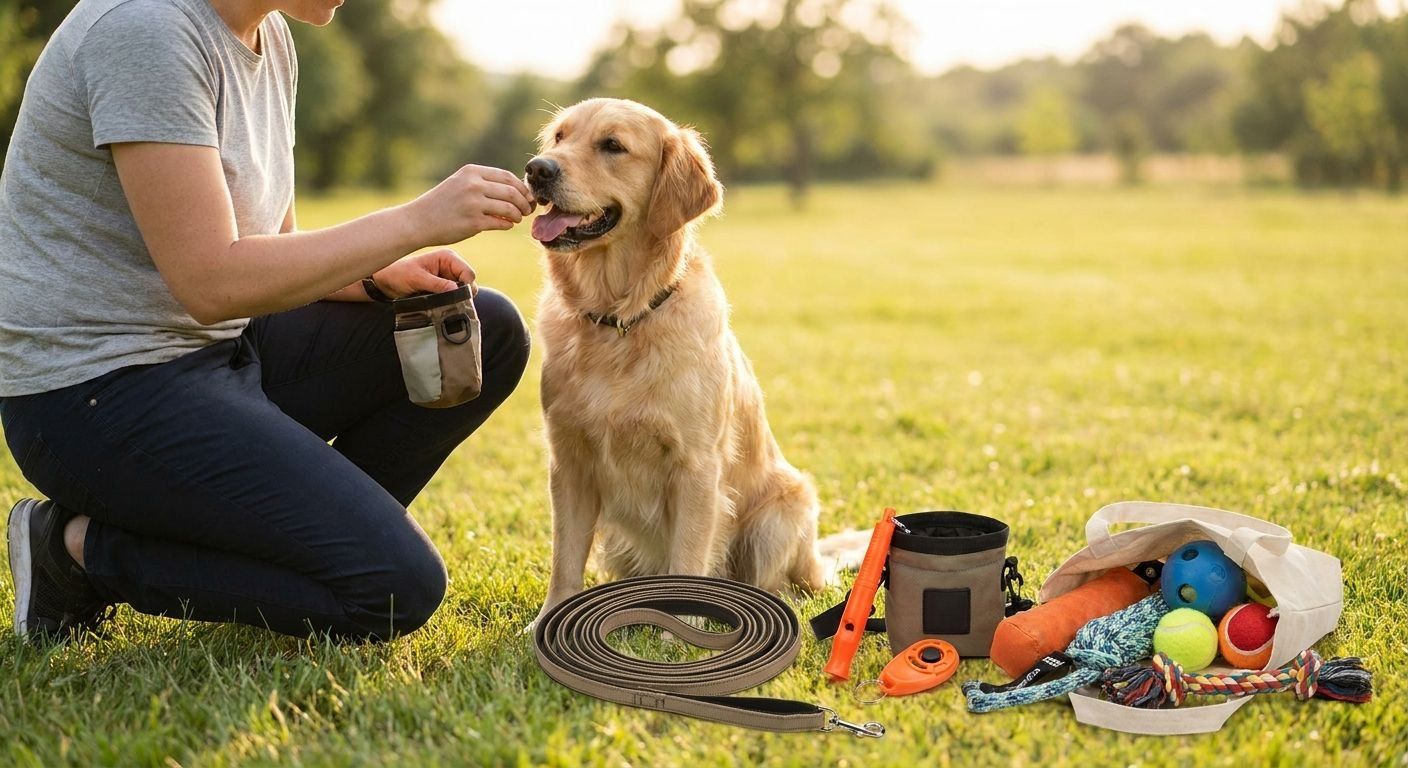
The best recall training equipment for 2026: long lines, treat pouches, whistles and GPS collars ranked, plus what to buy first for reward-based recall.
Recall training equipment won’t fix a dog who ignores you at the park, but the wrong kit will sabotage even a solid reward-based method before you get past week one in 2026. This guide ranks the gear that actually earns its place in your training bag, and names what to leave on the shelf.
Why this matters
Most recall problems aren’t a training method problem, they’re a friction problem. A dog who has to wait while you dig through a coat pocket, or one clipped to a retractable lead that keeps tension on his collar, is getting mixed signals no matter how good your technique is.
The right equipment removes that friction so the reward-based method actually gets a fair test. That’s the whole job of this list: gear that makes recall training for Surrey dog owners faster to run and easier to repeat, not gadgets that replace the work.
How this list was ranked
Every item here gets judged on four things, whether it gives you real control without pressure or pain, how fast it lets you deliver a reward inside that 1-3 second window dogs actually learn in, how it holds up outdoors in mud and rain, and whether it encourages the dog to check in voluntarily rather than just tolerate the lead. Equipment that fails any one of those gets marked down, no matter how popular it is.
This is the same short list used to set up 1:1 sessions through the 1:1 recall training programme . Owners get told exactly what to bring before session one, and it’s rarely more than three items.
The ranked list
1. Biothane long line (5-10m) – the non-negotiable
A biothane long line gives a dog room to practise real distance recall without the risk of losing them near a road. Unlike cotton webbing, biothane doesn’t soak up mud or freeze stiff in winter, and it won’t fray into a hand-burning mess after a few muddy walks.
Five metres works for hedgerow-lined fields, 10 metres in open parkland where you want distance before the recall cue. This is the single piece of recall training equipment worth buying before anything else on this list. Buy.
2. Quick-access treat pouch – the unsung hero
A treat pouch is the difference between rewarding within 1-3 seconds and fumbling for 8 seconds while the moment passes. Dogs learn fastest when the reward lands the instant the behaviour happens, and pocket-digging kills that timing every time.
Look for one with a waist strap rather than a belt clip as it’ll stay put during a jog to catch up with an excitable puppy. Buy.
3. Soft, pea-sized, high-value treats – the fuel
Dry biscuit treats take too long to chew and break the momentum of a recall sequence. Soft, pea-sized pieces of something the dog rarely gets otherwise, such as cooked chicken, cheese, a specific training treat is best as these get swallowed in one bite and keep the session moving.
Value matters more than variety here. If you use the same treat for everything it loses its pulling power outdoors, where distractions are stronger. Buy.
4. A marker word or clicker – the free one
A marker word like “yes”, or a clicker tells the dog the exact instant they’ve earned the reward, even before the treat physically arrives. This closes the gap between behaviour and reward far more precisely than a treat pouch alone can.
It costs nothing beyond a few minutes of practice pairing the sound with a treat, and it works indoors before you ever leave the house. Buy.
5. A well-fitted Y-front harness – the safety net
A harness that sits across the chest and around the shoulders, rather than a flat collar, stops a lunging dog from choking or hurting themself when the long line goes taut. It also gives you a physical point of control that doesn’t rely on neck pressure, which matters if recall training happens alongside loose lead work too.
A collar alone is fine for the marker and treat drills but isn’t enough once you’re on a walk or the long line is clipped on near open ground. Pair the two rather than choosing one. Anyone working on both skills together will find crossover with how to train a dog to walk on a loose lead. Buy.
6. Gundog-style recall whistle – the consistency hack
A whistle produces the exact same pitch and tone every time, unlike a human voice that changes with stress, distance, or a cold. That consistency matters for dogs who’ve started tuning out a verbal cue that’s been repeated too many times without a reward behind it.
It’s not essential for every dog, but for one who’s already partly deaf to “come” outdoors, a whistle can reset the cue from scratch. Consider.
7. GPS tracking collar – the wildcard
A GPS collar won’t teach a dog to come back, but it gives peace of mind for nervous rescues or high prey drive breeds during the training window when recall still isn’t reliable. It’s a safety net for the moments training hasn’t caught up to yet, not a substitute for the reward-based work itself.
Battery life and signal range vary a lot between models, so check both before relying on one in an area with patchy coverage. Consider.
The one to skip: retractable leads
A retractable lead keeps constant tension on the dog, which teaches a dog that pulling is normal and that the line will always give more. That’s the opposite of what recall training needs. We want a slack line and a dog choosing to move toward you, not away from you. Skip.
Comparison at a glance
| Equipment | Best for | Key benefit | Verdict |
|---|---|---|---|
| Biothane long line (5-10m) | Every recall session outdoors | Safe distance without losing control | Buy |
| Treat pouch | Fast, consistent reward timing | Cuts reward delay to under 3 seconds | Buy |
| Soft high-value treats | Keeping motivation high | Swallowed fast, no chewing pause | Buy |
| Marker word or clicker | Precise timing at any distance | Bridges the gap before the treat lands | Buy |
| Y-front harness | Dogs who lunge on the long line | No neck pressure during a hard pull | Buy |
| Recall whistle | Dogs tuning out verbal cues | Identical tone every time | Consider |
| GPS collar | Nervous or high-drive breeds | Locates a dog mid-training | Consider |
| Retractable lead | Nothing recall-related | Teaches pulling, not returning | Skip |
Where to source it
- Buy the long line from a specialist training retailer rather than the cheapest one, because biothane quality varies more than the price tag suggests.
- Choose a treat pouch by the closure mechanism, not the look of it. A flap that flips open on a run is worse than no pouch at all.
- Skip multi-packs of the cheapest treats on the shelf. One genuinely high value option beats five mediocre ones for recall work.
Puppies need the same core kit from week one, just scaled down. My puppy training programme starts recall foundations with nothing more than a treat pouch and a marker word before a long line is ever introduced.
One last thing
The piece of recall training equipment that changes outcomes the most isn’t the long line or the harness, it’s the association you build between your recall word (e.g. ‘Come’) and the reward received (in a timely manner!).
Related guides
FAQ
What is the best recall training equipment for 2026?
A 5-10m biothane long line, a quick-access treat pouch and soft high-value treats cover the core of recall training equipment for 2026. A marker word and a well-fitted Y-front harness round out the essentials for most dogs.
Do I need a clicker for recall training?
No you don’t have to. A clicker is one option but a consistent verbal marker word like "yes" works just as well. What matters is that the marker is used the same way every single time.
Is a retractable lead good for recall training?
No, a retractable lead keeps constant tension on the dog and teaches pulling rather than voluntary return. A fixed-length long line gives a slack line and clearer feedback.
How long should a training long line be?
5 metres works well in hedgerow-lined fields, and 10 metres suits open parkland where more distance is needed before the recall cue. Biothane holds up better than cotton webbing in wet or muddy conditions.
Does a GPS collar help with recall?
A GPS collar tracks a dog’s location but doesn’t teach them to come back on cue. It’s useful as a safety net, but not a recall solution by itself.
What treats work best for recall training?
Soft, pea-sized, high-value treats that get swallowed in one bite work best because they don’t interrupt the training sequence. Dry biscuits that need chewing slow the session down and reduce reward speed.
Can I train recall without any equipment?
Indoors, yes because a marker word and treats are enough to start. Outdoors near open space or roads, a long line and harness add the safety margin needed while recall is still unreliable.
How much lead length do I need for recall in open fields?
10 metres is a practical maximum for most open fields, giving enough distance to practise a real recall without losing physical control. Longer lines become difficult to manage and tangle more easily.